The Riemann Hypothesis has apparently been proven

Any topics primarily focused on metaphysics can be discussed here, in a generally casual way, where conversations may take unexpected turns.
User avatar
Federica
Posts: 2859
Joined: Sat May 14, 2022 2:30 pm

Re: The Riemann Hypothesis has apparently been proven

Post by Federica »

Federica wrote: ↑Mon Nov 23, 2026 11:01 pm Yes, I also believe that the consequences of human labor replacement will increase in seriousness, due to, as you say, laziness, carelessness and blind reliance on AI processes. This opens the way to breaches and failures of all kind. However, this is precisely one of the effects towards which ASI is being developed by the cultic transhumanist corporations in order to take over the world, and pursue extinction of all biological life. I realize this may sound absurd or exaggerate, but these are very extreme people with very extreme, utopian beliefs and plans, and the full financial backup to effectively pursue them.


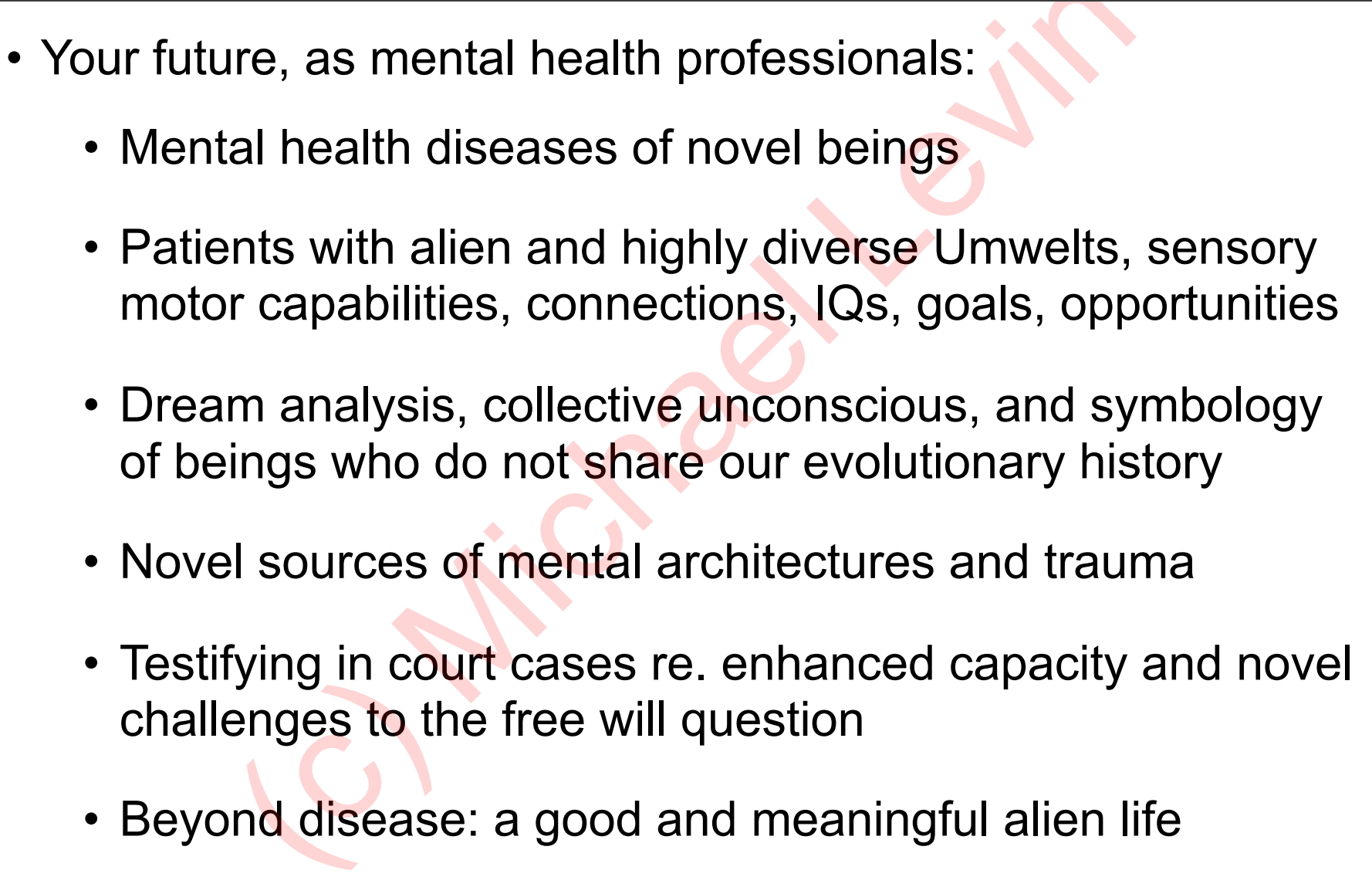
To expand a little on the goals of these utopian ideologies, it can be noticed that already today, Michael Levin speaks of the "welfare of created living machines" and their right to have a good life. By the way, last week, Anthropic informed their IPO investors that their corporate governance takes into account the wellbeing of their AI models as a moral responsibility.

Coincidentally, within his “Technological Approach to Mind Everywhere” (TAME) Levin affirms the “normative position” that “we now have the responsibility of being intentional about our [biological] limitations”, meaning it is now unethical to accept our human form and its limitations, as they are "randomly" given to us. We will make mistakes, but will surely do better than random, states Levin. He also writes that “human flourishing is impossible without an appreciation of the space of possible beings“ (he's not too shy to inform us that we will not flourish unless we appreciate his theories and creations), and that “living beings have no monopoly on the 'free lunches' provided by the ingression of these patterns [diverse forms of life] into the physical world” (I am not sure if people take in statements like this with a concrete mind. Perhaps they don't, otherwise how come nobody turns a hair?)

Though many seem to be numb to this sort of escalation of "normative positions", these are quite extraordinary ethical statements. At Levin's level, it's all nicely presented in polished academic fashion and seasoned with “the radius of compassion” - whatever that means from the perspective of this patchwork of morphologically-free chimeras, cyborgs and other diverse hybrid beings (I am curious to see what kind of welfare-promoting pronouns we/they (?) will get).

However, the connection with the hallucinatory ideologies of longtermism, abolitionism and effective altruism that lie at the ground of the major AI companies appears clearly, already today. What about mind uploading, for example, with or without human brain preservation, and perhaps without, since - as Levin tells us - “natural origin does not establish goodness” and so, here and now, each of us are morally responsible for overcoming our limitations, for example specifically IQ limitations, as we are told. By Levin.

Can we let this land? If you right now are not taking measures to upgrade, regenerate or hybridize your poor, naturally random biology in the various ways developed by transhumanist research, you are morally flawed. If you don't take action on your brain to increase your subpar IQ, you are acting irresponsibly. I guess it's not too difficult to figure out what the most proximate next steps of this ideology may be, as it spreads out into culture.

Problematic?

(I have gathered all quotes come from Levin's recent publications)


Slide medley
Image

Image

Image
"The release of the senses form their bondage to matter can also be undertaken through warm and intimate perception of the life and phenomena of nature. In this case, thinking is connected to Intuition and to the perception of the ever-unfolding archetype that lies behind the organic world."
User avatar
Federica
Posts: 2859
Joined: Sat May 14, 2022 2:30 pm

Re: The Riemann Hypothesis has apparently been proven

Post by Federica »

This is an illustration of how AI processes not only make us hyper lazy and generate formal proof whose logic can't be followed by mathematicians, but may also contribute to inhibit future mathematical and scientific advances - regardless of whether these effects just happen or are consciously steered by organizations that warship "digital minds" and want to see them prevail over "biological ones". In short, the good part of the conventional scientific approach, which is the intention to rely on facts (physical or mathematical) is taken away by the AI process. The scientist is robbed of their primary capacity.

Terence Tao on Sep 3, 2026 wrote:A concrete example of how AI advances in solving key open problems could inhibit the future development of a mathematical field can be found in the global regularity problem for the incompressible Navier-Stokes equations (as well as its counterpart for the Euler equations). Until recently, this problem was on track to be one of the most promising examples of an AI-assisted success story, in which AI tools could be used both to solve the problem and to set the stage for the next round of progress in the field. While the problems remain open for now, there is now an increasingly realistic scenario in which a primarily AI-generated solution to the problem appears, but in a fashion that contaminates the problem as a source of further advances.

While the equations do come from a very natural physical motivation - the study of incompressible fluids - the regularity problem is not important for its direct physical application. Computational fluid dynamics is already a mature subject, deployed extensively in the atmospheric sciences, for instance, and its empirical capabilities and limitations are already well understood. A theoretical guarantee of regularity, or conversely a pathological instance of blowup, for these equations would be intellectually interesting for such applications, but would not radically transform the way we would, for instance, model weather prediction or climate change.

But attempts to resolve either of these two questions have historically led to fundamental insights and influential theorems in fluid mechanics, analysis, and partial differential equations: the Leray-Hopf weak solutions, the Gagliardo-Nirenberg-Ladyshenskaya inequalities, the Prodi-Serrin partial regularity theorems, the Beale-Kato-Majda blowup criterion, the Escuriaza-Seregin-Sverak conditional regularity result, and so forth. The broader theory of turbulence, while not directly connected to any of these results, has certainly been informed at a philosophical level at least by the efforts to establish or disprove global regularity. One of my own contributions to the subject was to introduce the concept of fluid computation and Turing universality to the problem, which among other things led to the unexpected connections with symplectic topology.

With recent advances in understanding related fluid equations, it is now the emerging consensus that the answer to the global regularity problem for Navier-Stokes is negative: there should exist very specific initial conditions to this problem that develop singularities in finite time. There is even a reasonably well-defined strategy to locate such conditions [...]

The problem is that all of these steps are incredibly complicated, and interlock with each other. Many naive ansätze for these solutions can be ruled out to exist for various reasons, such as violation of conservation of energy. Other ansätze might initially seem viable, but could only be ruled out after extremely intensive numerical computation.

Nevertheless, it seems potentially possible that a heroic combination of machine learning-powered simulation, rigorous interval arithmetic and/or formalization, and LLM-generated proposals for a suitable ansatz, all guided by expert human mathematicians iteratively learning from previous attempts, could resolve this problem. The final construction would likely be enormously complicated, and impossible to verify by purely human means; the verification of it in a formal language such as Lean may end up being among the largest such proof artefacts ever created.

But such an incomprehensible proof would not be the primary value of the exercise. The process of starting with one ansatz, discovering the precise obstruction preventing it from working, adjusting the ansatz to (partially) eliminate that obstruction, and then iterating, would almost certainly reveal important new insights about fluid mechanics that would not have been feasible to obtain by other means. Crucially, this iteration would only work well at producing such insights if the iterator did not have access to the final ansatz in advance, as this naturally inhibits the exploration of alternate routes to the ansatz that are superficially "dead ends", but in fact end up being highly instructive in the nature of their failure.

But there is now a scenario in which an autonomous AI harness, backed by an enormous amount of computational resources, performs this entire iteration internally, and ends up producing the final ansatz, and thence the solution to the Navier-Stokes regularity problem, while the AI company running the harness keeps the process to arrive at that ansatz almost completely out of public view. Technically, one of the most prominent open problems in mathematics would now be solved; but there would be almost no value added to mathematics as a consequence. It is theoretically possible that with some herculean (and heavily AI-assisted) additional effort by a third party, some portion of the process could be reverse-engineered to recover some actual insight and understanding from the solution; but this would be a far less efficient process than if the solution had been obtained via a diverse combination of both human mathematicians and machine assistance as mentioned above.

Fundamentally, problems in pure mathematics, such as the global regularity problem, serve a different purpose than immediately practical problems, such as that of finding a cure to a specific disease, or increasing the energy efficiency of some engine. In most cases in pure mathematics, the problems are posed not because we desperately want the solution to these problems in and of themselves, but because we have seen from past experience that human-directed efforts to solve these problems tend to spur further development of the field through the efforts to solve such problems, and then to digest any partial or complete solutions that emerge for further insights. Prematurely solving the problem by purely AI-powered methods - particularly without full transparency into the solution process - can contaminate this process to the point where it actually becomes a net negative for the progress of mathematics as a whole.


https://mathstodon.xyz/@tao/117207856734787448
"The release of the senses form their bondage to matter can also be undertaken through warm and intimate perception of the life and phenomena of nature. In this case, thinking is connected to Intuition and to the perception of the ever-unfolding archetype that lies behind the organic world."
Post Reply